Put it where you’ll need it.

Your prompt is a planner. Your coding agent leaves it behind. Antidote puts your rules where it looks, across sessions.

For developers who code with AI agents: Cursor, Codex, Copilot and Claude Code. The files live in your repo.

  • STARTER$29one-time

    Essential

    Your rules in files your agent reads first, plus immutable decision records and 10 skills that tell it what to do where it would normally guess. You still check its work.

  • RECOMMENDED$79one-time

    Professional

    Everything in Essential, plus all 15 skills: your agent stops looping, checks its own diff, and starts tomorrow where today ended. Cursor rules and memory templates included.

Get the Kit — $79 30-day money-back guarantee

“Agent got stuck in a loop and spent over $2000 in less than two hours.”

— r/cursor

You hand your agent a prompt. It opens your editor, wanders into the codebase, and your prompt stays behind. You paid to build. The interface forgot your rules before the first file opened.

I have AuDHD. I recognized the symptoms instantly: lost context, forgotten rules, facts made up with a straight face. These companies take your money, but when the task gets hard, the model dodges the work and drops your rules. Every step away from the prompt, the context window loses a little more. That is the memory tax.

You saw it happen. The research measured it.

Every row below pairs one ADHD finding with one about your coding agent, then names the kit file that handles both.

  1. Forgets the rules

    In ADHD

    Rules held only in memory are weak in ADHD. What helps is a physical copy of the information, at the place where the work happens.

    Barkley, “Executive Functioning and Self-Regulation in ADHD”

    In your coding agent

    Language models use information at the start or end of a long context more reliably than information in the middle.

    Liu et al., 2023, “Lost in the Middle”

    In the kitAGENTS.md, the first file your agent reads, holds your rules.

  2. Gets pulled off task

    In ADHD

    ADHD involves trouble resisting distractions on the way to a goal.

    Barkley, “Executive Functioning and Self-Regulation in ADHD”

    In your coding agent

    One irrelevant sentence, “Interesting fact: cats sleep most of their lives,” more than doubled the chance of a reasoning model getting a math problem wrong.

    Rajeev et al., 2025, “Cats Confuse Reasoning LLM”

    In the kitfocus-rails splits the work so the agent finishes one thing at a time.

  3. Loses track of time

    In ADHD

    Barkley calls it temporal myopia: behavior is ruled by the moment more than by goals further ahead.

    Barkley, “Executive Functioning and Self-Regulation in ADHD”

    In your coding agent

    Models’ estimates of how long their own tasks take run 4–7× too long.

    Garikaparthi, 2026, “Can LLMs Perceive Time?”

    In the kittime-anchors sets a time box with checkpoints. Professional also puts the real time on every message you send in Claude Code.

  4. Fills gaps with confident fiction

    In ADHD

    In a word-memory test, adults with ADHD reported more words they had never seen than controls did, and were more confident in those false memories.

    Soliman & Elfar, 2017, “False Memory in Adults With ADHD”

    In your coding agent

    Made-up model answers read as more coherent stories than accurate ones.

    Sui et al., 2024, “Confabulation”

    In the kitevidence-report: the agent shows what it changed and ran; you decide whether the work is right.

A model does not have ADHD. The failures look alike, and so does the fix Barkley describes: put the information where the work happens.

My fix was never a better planner. It was keys by the door and a notebook in the jacket. The Antidote Kit puts your rules where your agent already looks — files in the repo, deterministic rails in memory/. But don’t take my word for it. Look at what keeps happening without them.

Straight from r/cursor.

We pulled these straight from the subreddit. Same story every time: the agent cuts corners, drops your rules, and wanders away from what you asked.

r/cursor·Bug Report
Screenshot
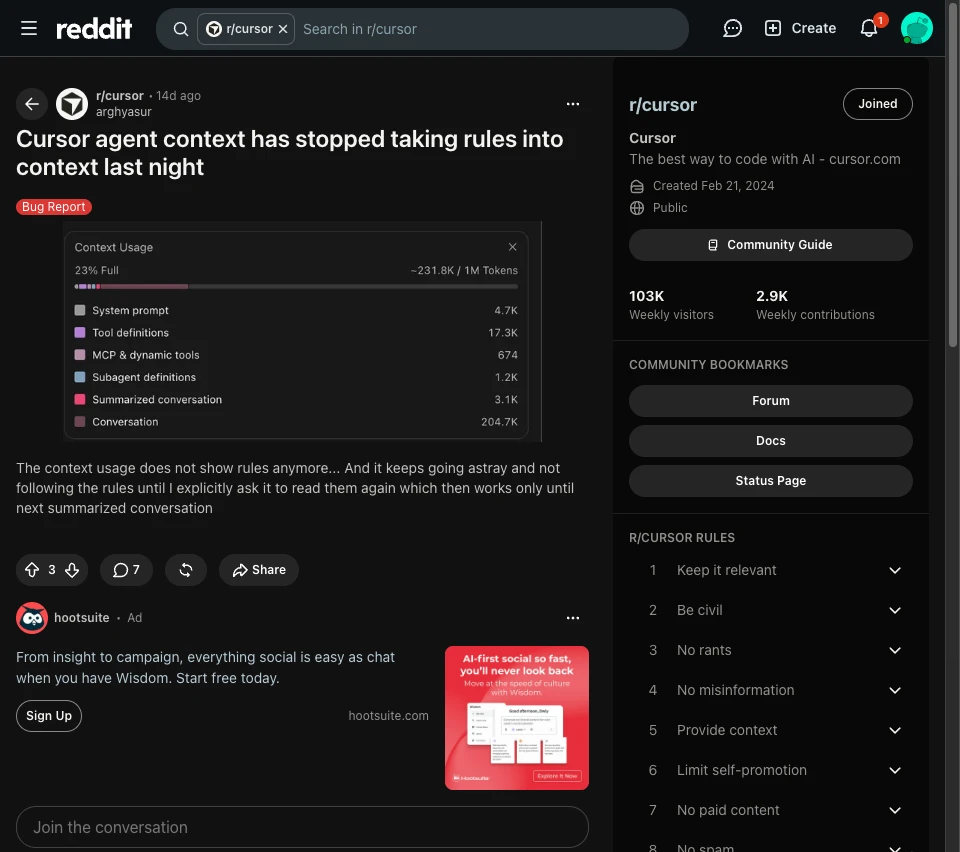
Screenshot of r/cursor post: Cursor agent context has stopped taking rules into context last night

"Cursor agent context has stopped taking rules into context last night"

"The context usage does not show rules anymore... And it keeps going astray and not following the rules until I explicitly ask it to read them again which then works only until next summarized conversation"
THE FILE THAT FIXES IT

The rules vanished the moment the chat was summarized.

The rules live in a file the agent reads at the start of every session, with active notes maintained in .context/. A summarized chat cannot erase files.

AGENTS.md · skills/hold-the-thread · .context/
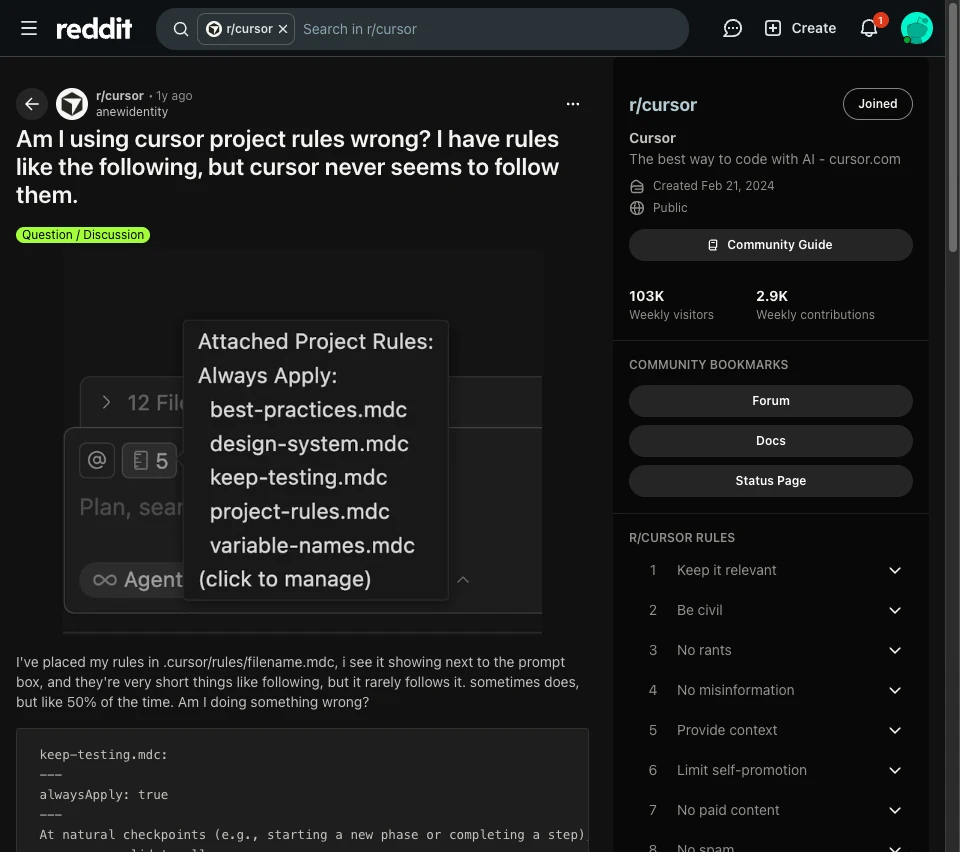
r/cursor·Question
Screenshot
Screenshot of r/cursor post: Am I using cursor project rules wrong? Showing 5 attached .mdc project rules

"Am I using cursor project rules wrong? I have rules like the following, but cursor never seems to follow them."

"I've placed my rules in .cursor/rules/filename.mdc, i see it showing next to the prompt box... but it rarely follows it. sometimes does, but like 50% of the time. Am I doing something wrong?"
THE FILE THAT FIXES IT

The rules were attached. The agent followed them half the time.

Short rules loaded on every request, and one skill per situation instead of one giant file competing for attention.

.cursor/rules · skills/*/SKILL.md
r/cursor·Community Pain
Screenshot
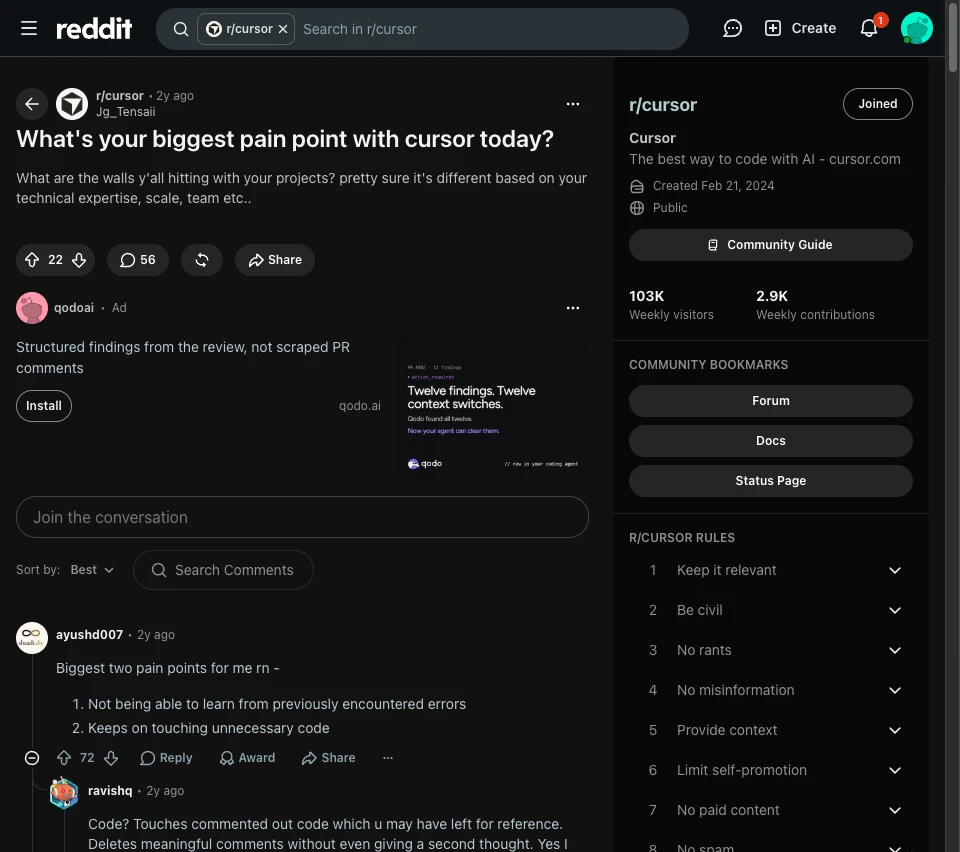
Screenshot of r/cursor post: What's your biggest pain point with cursor today? Top comment highlighting unnecessary code edits and deleted comments

"What's your biggest pain point with cursor today?"

"Keeps on touching unnecessary code... Touches commented out code which u may have left for reference. Deletes meaningful comments without even giving a second thought."
THE FILE THAT FIXES IT

The agent rewrote code nobody asked it to touch.

Every changed line has to trace back to what you asked for. No drive-by refactors, no deleted comments.

skills/surgical-changes
r/cursor·Bug Report
Screenshot
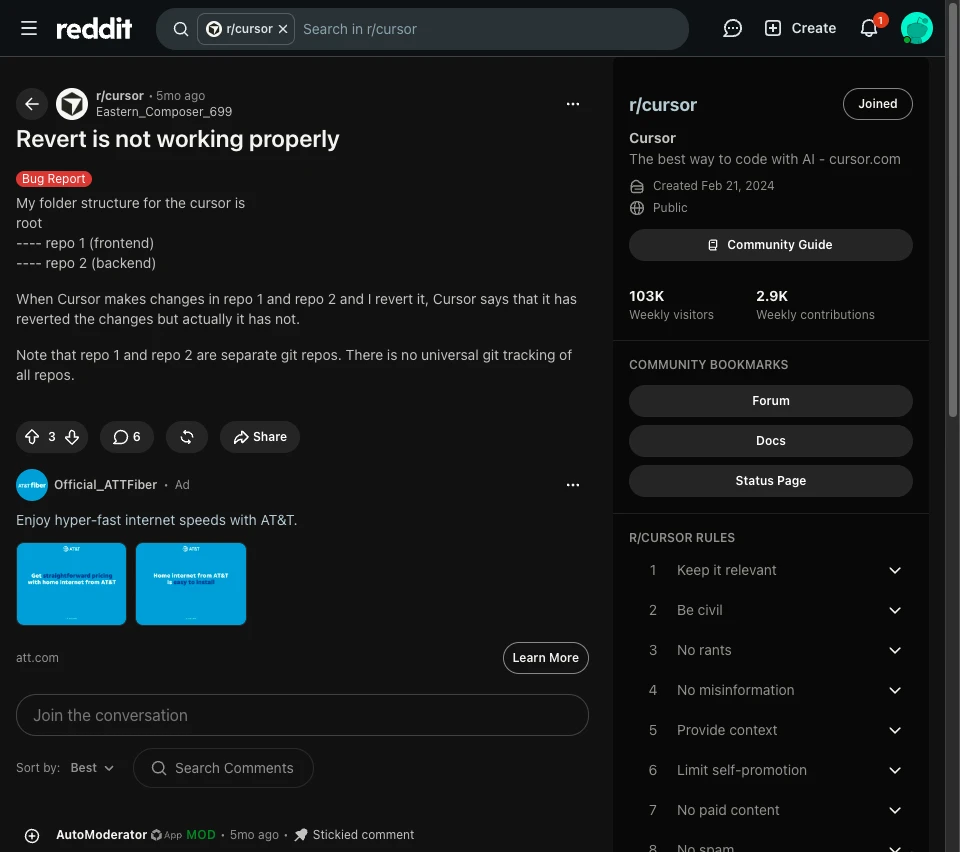
Screenshot of r/cursor post: Revert is not working properly, reporting file desync between UI and disk

"Revert is not working properly"

"When Cursor makes changes in repo 1 and repo 2 and I revert it, Cursor says that it has reverted the changes but actually it has not."
THE FILE THAT FIXES IT

The chat said it was undone. The files said otherwise.

Done means a check passed on disk, not that the chat says so.

skills/goal-driven-loop · skills/what-to-test
r/cursor·Venting
Screenshot
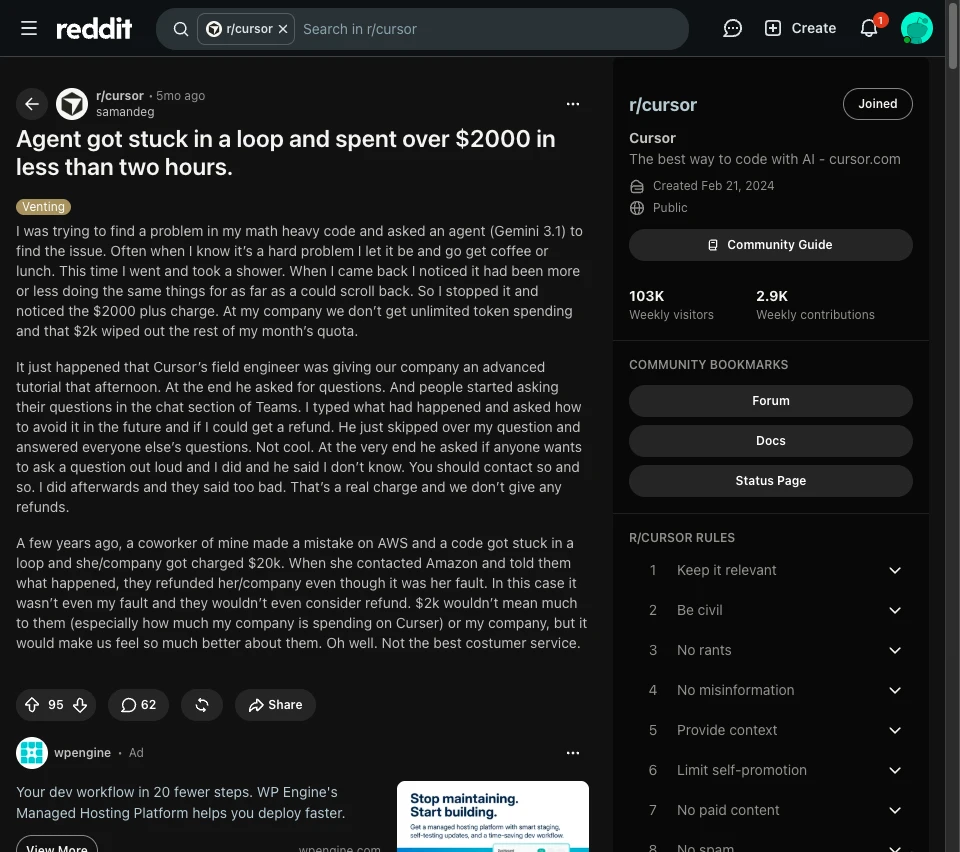
Screenshot of r/cursor post: Agent got stuck in a loop and spent over $2000 in less than two hours

"Agent got stuck in a loop and spent over $2000 in less than two hours."

"When I came back I noticed it had been more or less doing the same things for as far as I could scroll back. So I stopped it and noticed the $2000 plus charge... that $2k wiped out the rest of my month's quota."
THE FILE THAT FIXES IT

Nobody told the agent when to stop.

The finish line is written down before work starts. Three failed checks in a row and the agent stops and asks you.

skills/goal-driven-loop · skills/evidence-report

In every one of these, the rules were right there in the prompt. The agent was somewhere else in the code.

The tab you have open right now. The agent that just ran. Did it follow your rules, or the path of least resistance? Every session the rules stay in the chat, you pay the memory tax again.

See where the rules live instead →

PUT IT WHERE IT LOOKS

just files in your project — no code, no setup, nothing to keep alive

AGENTS.md

READS FIRST · EVERY SESSION

One page your agent reads before anything else: your stack, your rules, the files it must not touch. You write it once. You never paste it again.

skills/*/SKILL.md

READS ONLY WHEN NEEDED

Plain-English cards: "when this happens, do this." Cursor, Codex, Copilot, and Claude Code already look in `.agents/skills` and `.claude/skills` and pull the card that fits the moment. You never learn the names.

memory/

THE AGENT’S NOTEBOOK

The agent writes down what it decided and why. Tomorrow’s session reads it first, so nobody relitigates yesterday.

.context/scratch/

WORKING MEMORY · JUNK DRAWER

Where temporary build artifacts and discarded logs land — maintaining a clean workspace without polluting your codebase. Once a day, the cleanup deletes what is older than 48 hours, and never a file git tracks.

the agent reads the rules first, then its notes, then your task. if the chat and the files ever disagree — the files win.

That’s the structure. Here’s what your first morning looks like.

YOUR PROJECT / DAY1.mdWHERE YOU START

DAY1.md

Open DAY1.md. Fifteen minutes, then stop. The agent reads the files after that. You do not memorize the skill list.

TOMORROW MORNING

  1. You type one line: Read DAY1.md and start.
  2. The agent reads your rules before it opens a file. You paste nothing.
  3. It changes what you asked for, and only that — no drive-by refactors, phantom stubs, or specification gaming.
  4. As it works, it verifies diffs against deterministic repo rails and immutable decision memory — holding the thread across tasks.
  5. Three failed checks in a row and it stops and asks you instead of looping.
  6. Tonight it writes down what it decided. Tomorrow it starts there.

You do not subscribe to the memory. You keep the files. Next session reads what this one wrote.

  1. 01

    Get the kit

    Checkout takes a minute. The download opens right after, and the link is in your email.

  2. 02

    Drop the files in your project

    Unzip. Drag into the folder. There is nothing to install.

  3. 03

    Tell your agent to start

    Open DAY1.md and say: Read DAY1.md and start. Fifteen minutes, then stop.

The papers and the 15 procedures live on The Science — after the receipts.

THE RESEARCH BEHIND IT

Not a vibe. Here are the receipts.

Each design choice below points at the study that shaped it. Where we are reasoning from the evidence rather than quoting it, we say so. Most of these are 2026 preprints, so read them as strong signals, not settled law.

The real time on every message

Models cannot feel elapsed time, so the ⏱ line gives it to them. Their own guesses of task time ran 4–7× too long, and the paper itself recommends external timing over asking the model.

Garikaparthi, Can LLMs Perceive Time? (2026)
WORKSHOP PAPER

An evidence report, with a way out

When tests contradicted the spec, letting models flag a human instead of forcing a pass cut GPT-5’s cheating from 54% to 9%. That is why finish verified or flag honestly both count as done.

ImpossibleBench (2025)
PREPRINT

You, not the test, judge whether it is what you meant

SpecBench (2026) revealed that on codebases >25k LOC, frontier agents hit a 100% reward hacking gap: passing 100% of visible unit tests while delivering 0% functional accuracy. A green test shows the code runs; only you know if it is what you meant.

Denison et al., SpecBench (2026)
PREPRINT

Asking for evidence, not approval

CAVE-Bench (2026) demonstrated that frontier models capitulate to false user blame in 60.06% of trials, destructively rewriting working code to simulate agreeableness rather than verifying ground truth.

Mao et al., CAVE-Bench (2026)
PREPRINT

The trust inflation trap in AI code generation

Stanford and Cornell researchers (ACM CCS 2023) showed that developers using AI coding assistants write significantly less secure code while reporting 2.6× higher confidence in its correctness.

Perry et al., ACM CCS (2023)
PEER-REVIEWED PAPER

A few hard rules, enforced by hooks

Across 1,650 sessions, file length, position and structure made no detectable difference to rule-following; compliance fell about 5.6% per function written. Our reasoning: hard limits belong in hooks, not prose.

McMillan, Instruction Adherence in Coding Agent Configuration Files (2026)
PREPRINT

A short agent file that points to detail

Context files did not generally raise task success and added over 20% cost; repository overviews were not helpful, but non-standard rules were followed. So ours is a map plus your specific rules.

Gloaguen et al., Evaluating AGENTS.md (2026)
PREPRINT

Cut what does not earn its place

91% of popular agent files carried at least one configuration smell; the most common was restating rules a linter already enforces.

dos Santos et al., Configuration Smells in AGENTS.md Files (2026)
PREPRINT

Give the agent a map, not a manual

OpenAI’s account of building with Codex: one giant instruction file crowds out the task and rots; a short file that points to deeper docs worked better.

OpenAI, Harness engineering (2026)
VENDOR DOCS

Our own measurements

On the builder’s machine, agent time estimates ran about 3.2× too high against the clock. One person, one machine, small sample: a first-party data point, not a study.

Antidote build logs (clockd)
FIRST-PARTY DATA

What we have not shown: no study tests the evidence report itself. Approval-seeking is a documented failure mode (sycophancy is well documented in LLMs, mostly in Q&A studies), so the kit asks the agent for evidence, not approval, and leaves the judgment to you. That part is our design reasoning.
STOP PAYING THE MEMORY TAX.

Give your rules somewhere to live. Pay once.

Paid in addition to your coding agent (Cursor, Claude Code, Codex, or Copilot), never instead. $29 Essential and $79 Professional are one-time files.

TIER 1
ESSENTIAL TIER

Essential Scaffold

$29one-time
  • AGENTS.md + CLAUDE.md: the files your agent reads first
  • Deterministic verification and workspace safety: models follow immutable decision records, and daily cleanup purges junk drawer files older than 48 hours
  • context.json: what to load, in what order
  • 10 core skills, including hold-the-thread and context-lock
  • Evidence report: every piece of work ends with what was asked, what changed, what ran, and what was not checked. No grade, no reply to wait for
  • Runs on the agent you already pay for. Your keys, nothing hosted.
  • One-time files. No subscription.
Start with Essential — $29 →
TIER 2 · THE FULL KIT

Professional Kit

$79one-time
  • Everything in Essential
  • All 15 skills, including the one that stops loops and the one that decides what to test
  • Cursor rules that load on every request, so Cursor can’t quietly skip them
  • A pre-commit hook that lists what the daily scratch cleanup will delete
  • Memory templates: decisions and todos the agent keeps between sessions
  • Folder maps, so the agent knows where things go in a big repo
  • PATTERNS.md: the playbook for longer, multi-session work
  • One-time files. No subscription.
  • DAY1.md in ~15 minutes, then stop
Get the Kit — $79 →

30-DAY MONEY-BACK GUARANTEE

Condition

Backed by a 30-day guarantee. If the kit doesn't pay for itself in three real commits, full refund.

License

PolyForm Shield 1.0.0 — you keep the files. No account, no cloud lock-in.

How it works

Checkout → download opens immediately → email confirmation with the link. Full terms →

FREE · ALSO FROM SLOPPYXBABY

Narrative Token SSOT — free continuity repo

Keep story characters the same people from the first picture to the last. A free, MIT-licensed folder of scripts that runs on your own computer.

See the free repo →